Introduction to the Latest Technologies in 2026
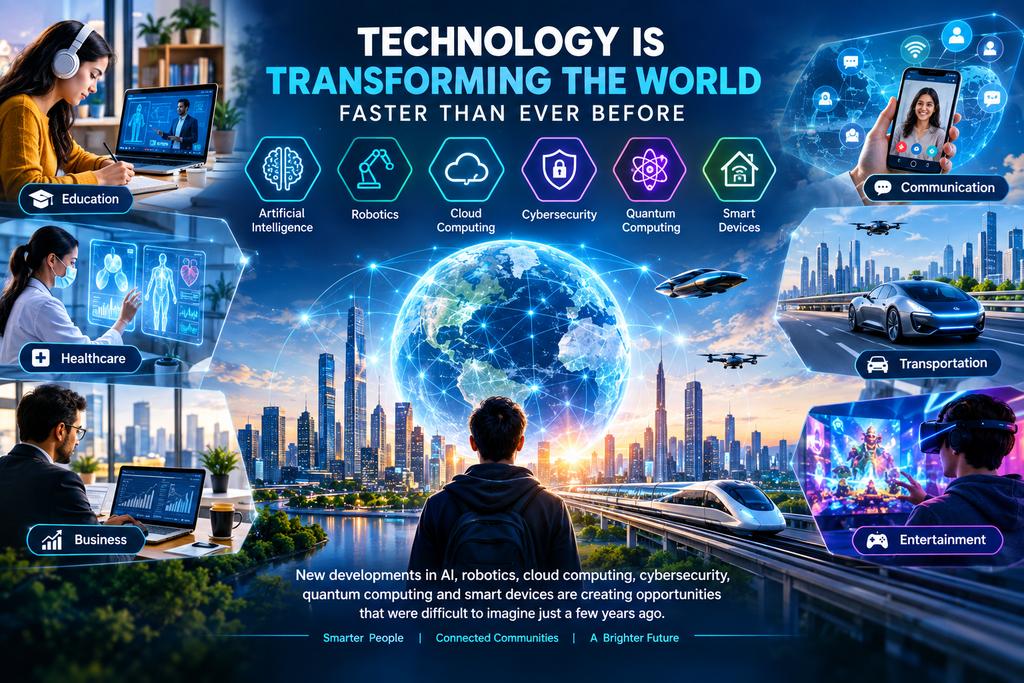
Technology is transforming the world faster than ever before. In 2026, technological innovation continues to influence almost every aspect of human life, from education and healthcare to business, communication, transportation, and entertainment. New developments in artificial intelligence, robotics, cloud computing, cybersecurity, quantum computing, and smart devices are creating opportunities that were difficult to imagine just a few years ago. Technology is no longer limited to computers and smartphones. It has become an essential part of modern society, helping people solve complex problems, improve productivity, access information, and connect with others across the world.
The latest technologies are changing how businesses operate, how students learn, how doctors treat patients, and how individuals interact with digital services. Artificial intelligence can help automate repetitive tasks, while advanced robotics can support manufacturing, logistics, and medical procedures. Cloud computing allows companies to store and process large amounts of data without maintaining expensive infrastructure. Meanwhile, cybersecurity technologies are becoming increasingly important as cyber threats grow more sophisticated. These innovations are not developing independently. Instead, they are increasingly working together to create intelligent, connected, and automated systems.
Understanding the latest technologies in 2026 is important for students, developers, entrepreneurs, business owners, and anyone interested in the digital future. Learning about these innovations can help individuals develop valuable skills, discover new career opportunities, and prepare for changes in the global economy. As technology continues to advance, the ability to understand and adapt to digital transformation will become an increasingly valuable advantage.
Artificial Intelligence Is Transforming the Digital World
Artificial intelligence, commonly known as AI, is one of the most influential technologies of the modern era. AI refers to computer systems that can perform tasks traditionally associated with human intelligence, including understanding language, recognizing images, analyzing information, generating content, and supporting decision-making. In 2026, AI continues to evolve beyond simple chatbots and basic automation. Modern AI systems can support complex workflows, assist with software development, generate multimedia content, and interact with digital tools.
Generative AI is an important area of this transformation. These systems can produce text, images, audio, video, and computer code based on user instructions. Businesses use generative AI to create marketing materials, prepare reports, summarize documents, and support customer service. Students can use it to understand difficult topics, organize research, and practice new skills. Developers can use AI-powered coding assistants to explain unfamiliar code, identify potential errors, and accelerate software development. However, AI-generated content still requires human review because these systems can sometimes produce incorrect, incomplete, or misleading information.
Another important development is AI agents. Unlike traditional conversational systems that mainly respond to individual prompts, AI agents can be designed to perform multiple connected tasks using software tools. For example, an AI-powered business assistant might organize information, prepare a draft report, analyze a spreadsheet, and help manage a workflow. These capabilities could improve productivity across many industries. However, the reliability of autonomous systems, access permissions, data protection, and human supervision remain important considerations.
Artificial intelligence is also becoming more common in healthcare, agriculture, finance, education, and transportation. In healthcare, AI can help analyze medical images and identify patterns in patient data. In agriculture, AI-powered systems can support crop monitoring, irrigation planning, and pest detection. Financial institutions can use machine learning to identify suspicious transactions and analyze market information. These applications demonstrate how AI can help professionals make better-informed decisions while emphasizing the importance of transparency, accuracy, and responsible implementation.
Machine Learning and Deep Learning Innovations
Machine learning is a branch of artificial intelligence that enables computer systems to learn patterns from data and improve their performance on specific tasks. Instead of relying entirely on manually programmed instructions, machine learning models identify relationships in training data and use those patterns to make predictions or classifications. In 2026, machine learning continues to support applications such as recommendation systems, fraud detection, speech recognition, predictive maintenance, and personalized digital experiences.
Deep learning is a specialized area of machine learning that uses artificial neural networks with multiple layers. It has played a major role in advancements in image recognition, natural language processing, autonomous systems, and generative AI. Modern deep learning models can process large and complex datasets, helping organizations extract useful information from text, images, audio, and video.
One emerging direction is the development of smaller, more efficient AI models. Large AI systems can require substantial computing resources, but smaller models can sometimes perform specific tasks directly on smartphones, laptops, industrial devices, and other local hardware. This approach, often called edge AI when processing takes place near the data source, can reduce latency and limit the need to transmit sensitive information to remote servers.
Machine learning also has limitations. Models can reflect biases in their training data, struggle with unfamiliar situations, or make inaccurate predictions. Organizations therefore need to test their systems carefully, monitor performance, and ensure that important decisions receive appropriate human oversight.
Robotics and Intelligent Automation
Robotics is another major area of technological development. Modern robots are becoming more capable of performing tasks that require movement, sensing, planning, and interaction with their surroundings. Traditional industrial robots have been used in factories for decades, particularly in repetitive manufacturing operations. Newer robotic systems increasingly combine artificial intelligence, computer vision, sensors, and advanced control technologies to operate in more flexible environments.
Humanoid robots are receiving considerable attention because their human-like structure may allow them to work in environments designed for people. Companies and research laboratories are exploring applications in manufacturing, warehouse operations, research, and assistance. However, widespread commercial deployment remains challenging because robots must demonstrate reliable movement, safety, adaptability, and reasonable operating costs.
Collaborative robots, often called cobots, are designed to work alongside human employees in certain controlled environments. They can assist with assembly, packaging, inspection, and material handling. Their use can reduce physical strain and support consistent production, while human workers continue to supervise processes and handle tasks that require judgment and flexibility.
Robotics is also advancing in healthcare. Surgical robots can help qualified medical professionals perform certain procedures with specialized instruments and precise control. Rehabilitation robots can support physical therapy, while robotic systems can help move supplies within hospitals. In agriculture, robots can assist with planting, harvesting, crop monitoring, and weed management.
Despite these opportunities, robotics introduces important challenges involving worker training, workplace safety, equipment maintenance, costs, and potential changes in employment. Successful adoption requires thoughtful planning and cooperation between technology providers, businesses, employees, and regulators.
Quantum Computing: A New Era of Computing Power
Quantum computing is an emerging technology based on the principles of quantum mechanics. Unlike classical computers, which process information using bits that represent zero or one, quantum computers use quantum bits, or qubits. Qubits can exhibit quantum properties such as superposition and entanglement, allowing certain quantum algorithms to approach computational problems differently from conventional systems.
Researchers are exploring quantum computing for areas such as molecular simulation, materials science, optimization, and fundamental scientific research. In the future, sufficiently advanced quantum computers could help scientists model complex chemical interactions that are difficult to simulate accurately with classical computers. This could contribute to research into new medicines, batteries, catalysts, and advanced materials.
However, quantum computing is still at an early stage compared with conventional computing. Building reliable quantum systems is extremely challenging because qubits are sensitive to environmental disturbances and computational errors. Researchers are working on error correction, improved hardware, and more practical algorithms. Current quantum computers are not general-purpose replacements for laptops, smartphones, or traditional data centers.
Quantum technology also has important implications for cybersecurity. Powerful future quantum computers could threaten some widely used public-key cryptographic methods. This has encouraged the development and adoption of post-quantum cryptography, which aims to protect information against attacks from both classical and future quantum computers. Organizations that handle sensitive information need to consider how long their data must remain secure and prepare for the transition to newer cryptographic standards.
Cloud Computing and Edge Computing
Cloud computing has become a fundamental part of modern digital infrastructure. It allows individuals and organizations to access computing power, storage, databases, and software through internet-connected services. Instead of purchasing and maintaining every server themselves, businesses can rent resources from cloud providers and adjust capacity according to their requirements.
In 2026, cloud computing continues to support artificial intelligence, online collaboration, digital commerce, software development, and data analytics. Cloud platforms allow companies to deploy applications across different regions, support remote teams, and manage large amounts of information. They also provide services such as automated backups, application hosting, data processing, and machine learning tools.
A growing trend is the combination of cloud and edge computing. While cloud systems provide centralized processing and storage, edge computing moves certain workloads closer to the devices generating or using the data. This can be particularly valuable for applications that require fast responses, including industrial monitoring, connected vehicles, smart cameras, and healthcare equipment.
For example, a smart manufacturing facility might use edge computing to detect unusual machine behavior immediately while sending selected information to the cloud for long-term analysis. This combination can reduce communication delays and help organizations manage network traffic more efficiently.
Cloud adoption also requires careful attention to cybersecurity, access management, data privacy, service reliability, and operating costs. Businesses need to understand where their information is stored, who can access it, and how to recover important systems if an outage or security incident occurs.
Cybersecurity and Digital Privacy in 2026
As digital technology becomes more deeply integrated into daily life, cybersecurity has become a critical priority. Individuals and organizations rely on connected systems for banking, communication, healthcare, education, shopping, and business operations. This dependence creates opportunities for cybercriminals who attempt to steal information, disrupt services, exploit software weaknesses, or gain unauthorized access to digital accounts.
Modern cybersecurity combines multiple technologies and practices. Artificial intelligence can help security teams identify unusual network activity, detect suspicious login patterns, and prioritize potential threats. Automated monitoring systems can analyze large volumes of security information more quickly than manual processes alone. However, attackers can also use AI to create convincing phishing messages, automate parts of their operations, and adapt their techniques.
Zero-trust security is an important approach in modern cybersecurity. Instead of automatically trusting users or devices because they are connected to an internal network, zero-trust systems continuously evaluate identity, permissions, device status, and access requests. Organizations may combine multifactor authentication, identity management, network segmentation, encryption, and continuous monitoring to reduce the impact of compromised accounts.
Digital privacy is equally important. As applications collect more information about users, organizations must make thoughtful decisions about what data they collect, how long they retain it, and how they protect it. Privacy-conscious technology design can help reduce unnecessary data collection and provide individuals with greater control over their information.
For everyday users, basic security practices remain valuable. Using strong and unique passwords, enabling multifactor authentication, installing security updates, avoiding suspicious links, and maintaining secure backups can significantly improve personal digital safety. Cybersecurity is not simply a technical issue; it is a shared responsibility involving technology companies, governments, businesses, and individual users.
5G Technology and the Development of 6G
Mobile communication networks have transformed the way people access information and communicate. Fifth-generation wireless technology, commonly known as 5G, provides higher potential data rates, lower latency in suitable conditions, and support for large numbers of connected devices. Its capabilities can benefit applications such as high-definition video streaming, industrial automation, smart infrastructure, and connected vehicles.
The actual performance of 5G depends on several factors, including spectrum availability, network configuration, coverage, device capabilities, and congestion. Not every 5G connection delivers the same speed or latency. Nevertheless, 5G continues to provide an important foundation for digital services that require faster and more responsive wireless communication.
Research into sixth-generation mobile networks, or 6G, is exploring possible advances beyond 5G. These include more integrated sensing and communication, intelligent network management, advanced spectrum technologies, and improved support for immersive digital applications. Researchers are also investigating the possible use of artificial intelligence to optimize network operations.
However, 6G is still under research and standardization rather than being a widely deployed commercial mobile generation. Its technical specifications, deployment timelines, and real-world capabilities will depend on future international standards, infrastructure investment, and regulatory decisions.
Future wireless networks could support new types of connected experiences, including more responsive remote collaboration, advanced industrial systems, and expanded communication between machines. At the same time, network security, energy efficiency, affordability, and access in rural areas will remain important challenges.
Internet of Things and Smart Technology
The Internet of Things, often abbreviated as IoT, refers to physical objects equipped with sensors, software, and network connectivity that allow them to collect and exchange data. IoT technology is used in smart homes, industrial systems, agriculture, healthcare, transportation, and environmental monitoring.
Smart home devices are among the most familiar examples. Connected thermostats can adjust temperature settings, smart lighting can respond to schedules, and security cameras can provide remote monitoring. These systems can make certain everyday tasks more convenient and help households manage energy consumption.
Industrial IoT is particularly important for businesses. Sensors installed on machines can monitor vibration, temperature, pressure, and other operating conditions. When combined with analytics, this information can help identify potential equipment problems before a major breakdown occurs. Predictive maintenance can reduce unplanned downtime and help companies schedule repairs more effectively.
Agricultural IoT systems can monitor soil moisture, weather conditions, irrigation equipment, and crop environments. Farmers can use this information to make more informed decisions about water use and field management. In cities, connected sensors can support traffic management, street lighting, waste collection, and environmental monitoring.
However, the growth of IoT also increases the number of connected devices that need to be secured. Poorly protected devices may expose personal information or provide attackers with access to larger networks. Manufacturers and users need to consider software updates, strong authentication, secure communication, and long-term device support.
Augmented Reality, Virtual Reality, and Mixed Reality
Extended reality is an umbrella term that includes augmented reality, virtual reality, and mixed reality. These technologies combine digital content with physical or simulated environments in different ways. They are creating new possibilities for education, training, entertainment, design, healthcare, and remote collaboration.
Virtual reality places users inside computer-generated environments through specialized headsets. It can be used for immersive gaming, simulated training, virtual tours, and educational experiences. For example, students may explore a virtual historical site or examine a simulated scientific environment without physically traveling there.
Augmented reality adds digital information to a view of the real world. A mobile application might display navigation directions over a camera image, help a technician identify equipment components, or allow customers to preview how furniture could look in a room.
Mixed reality combines aspects of physical and digital environments, allowing virtual objects to interact with a user’s surroundings in more integrated ways. These systems may support design reviews, industrial maintenance, collaborative visualization, and specialized professional training.
Although extended reality offers significant creative potential, adoption depends on comfort, accessibility, device cost, battery life, content quality, and practical usefulness. Privacy is another important concern because some devices collect environmental information, spatial data, or other sensitive details.
Blockchain and Web3 Technologies
Blockchain is a form of distributed digital recordkeeping in which information is organized into linked blocks and maintained through a network of participating computers. Depending on its design, a blockchain can provide shared records, cryptographic verification, and mechanisms for coordinating transactions without relying entirely on one central database.
Blockchain technology is associated with cryptocurrencies, but its possible applications extend beyond digital currencies. Researchers and businesses have explored its use in supply-chain tracking, digital identity, asset records, and automated agreements known as smart contracts.
Smart contracts are programs deployed on supported blockchain networks that execute specified actions when predefined conditions are met. They can automate certain types of digital transactions, but they cannot automatically guarantee that the information entering the system is accurate. Poorly written contracts can also contain vulnerabilities that lead to financial losses.
Web3 is a broad term used for ideas about internet services that incorporate blockchain-based ownership, decentralized applications, and user-controlled digital assets. The term covers many different projects and architectures rather than one universally agreed technical standard.
In 2026, blockchain development continues to face questions about scalability, energy consumption, usability, regulation, privacy, and security. Businesses evaluating blockchain should compare it with conventional databases and distributed systems instead of assuming that decentralization is automatically necessary or beneficial.
Green Technology and Sustainable Innovation
Environmental sustainability is becoming an increasingly important part of technological development. Green technology includes innovations designed to reduce environmental harm, improve resource efficiency, and support cleaner energy systems. These technologies can help address challenges related to climate change, pollution, energy demand, and resource management.
Solar and wind power continue to play important roles in the transition toward lower-carbon electricity systems. Improvements in energy storage, grid management, and forecasting can help integrate variable renewable energy sources more effectively. Battery technologies are also advancing, supporting applications in electric vehicles, portable electronics, and stationary energy storage.
Artificial intelligence can contribute to energy efficiency by forecasting electricity demand, identifying equipment problems, and optimizing certain industrial operations. Smart building systems can monitor heating, cooling, and lighting to reduce unnecessary energy consumption. In agriculture, precision technologies can help manage irrigation and fertilizer use more carefully.
Electric vehicles are another important area of sustainable innovation. Advances in battery design, charging infrastructure, power electronics, and vehicle software are influencing transportation. However, the environmental impact of electric vehicles depends on factors such as electricity generation, battery production, vehicle lifetime, and recycling systems.
Technology itself also has an environmental footprint. Data centers, semiconductor manufacturing, electronic devices, and AI computing require energy and materials. Sustainable innovation therefore involves not only developing cleaner products but also improving the efficiency, repairability, recycling, and responsible use of technology.
Biotechnology and Digital Healthcare
Biotechnology is combining with digital technologies to create new approaches to medical research, diagnosis, treatment, and healthcare delivery. Advances in genomics, laboratory automation, medical imaging, wearable sensors, and computational biology are allowing researchers to investigate complex biological systems in increasingly detailed ways.
Artificial intelligence can help analyze medical images, organize scientific literature, identify patterns in large datasets, and support certain clinical workflows. These tools may help medical professionals manage information and investigate possible findings more efficiently. However, clinical AI systems must be carefully validated and monitored, and their outputs should be interpreted by qualified professionals.
Wearable devices can track measurements such as heart rate, activity, sleep patterns, and, in some devices, additional health-related indicators. This information may help people understand certain aspects of their daily habits and support discussions with healthcare professionals. Consumer wearables are not substitutes for medical diagnosis, and the accuracy of their measurements varies by device and use case.
Telemedicine continues to expand access to certain healthcare services by enabling remote consultations and digital follow-up. When combined with secure health records and remote monitoring, it can help healthcare providers support patients outside traditional clinical settings.
Biotechnology also includes developments in gene editing, advanced diagnostics, and personalized medicine. These fields offer research opportunities while raising significant questions about safety, affordability, ethics, and equitable access. Responsible progress requires scientific evidence, appropriate regulation, informed consent, and careful protection of medical data.
The Future of Software Development
Software development is changing as AI-assisted coding tools, cloud platforms, low-code environments, and automated testing become more widely available. Developers can use AI assistants to generate code suggestions, explain unfamiliar functions, draft tests, and identify possible errors. These tools may accelerate routine work and help programmers explore alternative solutions.
However, AI-generated code is not automatically secure, efficient, or correct. Developers still need to understand software architecture, review generated output, test important functionality, and evaluate security implications. Strong programming fundamentals remain valuable because they allow developers to recognize problems and make informed technical decisions.
Low-code and no-code platforms are also making certain types of application development more accessible. These systems use visual interfaces, reusable components, and workflow builders to help users create business applications without writing every line of code. They can be useful for internal tools, prototypes, and straightforward business processes, although complex applications may still require traditional programming.
Modern software teams are increasingly adopting practices such as continuous integration, automated deployment, infrastructure as code, and observability. These approaches can improve software quality and make it easier to detect and resolve problems. As development tools become more powerful, the ability to design reliable systems and understand user needs remains central to successful software engineering.
Technology Skills and Career Opportunities in 2026
The growth of emerging technologies is creating demand for people with technical skills and the ability to adapt. Artificial intelligence, data analysis, cybersecurity, cloud infrastructure, software development, robotics, and digital product design are important areas for continued learning. Opportunities vary by country, industry, education, and experience, so career planning should take local conditions into account.
Students and beginners can build a foundation by learning programming, computer fundamentals, problem-solving, communication, and digital literacy. Python is often used for data analysis, automation, and machine learning, while JavaScript is widely used in web development. Other languages and tools may be useful depending on a person’s goals.
Practical projects are an effective way to develop and demonstrate skills. Building a website, creating a small mobile application, analyzing a public dataset, automating a repetitive task, or experimenting with a simple AI model can provide experience beyond theoretical study. A portfolio can help present this work to potential clients, employers, or collaborators.
Continuous learning is especially important in technology because tools and standards change over time. Rather than focusing only on temporary trends, learners can benefit from understanding fundamental concepts and applying them to real-world problems. Technical knowledge combined with creativity, critical thinking, collaboration, and ethical judgment can support long-term professional growth.
Challenges and Ethical Considerations of Emerging Technologies
Although emerging technologies provide many benefits, they also create challenges that society must address. Automation can change job responsibilities and reduce demand for some routine tasks. AI systems can produce biased or inaccurate results. Connected devices can expose personal information, and complex software can introduce security vulnerabilities. These issues require thoughtful decisions rather than assuming that every new technology will automatically improve people’s lives.
Data privacy is one of the most important concerns. Digital systems may collect personal details, location information, communications, and behavioral data. Organizations should explain their data practices, collect only information that is necessary, protect stored records, and provide appropriate user controls.
Another challenge is the digital divide. People in rural communities or lower-income regions may have limited access to reliable internet, modern devices, digital education, or technical support. If technological progress benefits only groups that already have access to resources, existing inequalities may become more difficult to address.
Environmental impacts also deserve attention. Training and operating some AI systems can require substantial computing resources, while electronic devices depend on materials and manufacturing processes that create environmental pressures. More efficient hardware, renewable energy, repairable products, and responsible recycling can help reduce these impacts.
Finally, transparency and accountability are essential when technology influences important decisions. People should be able to understand when automated systems are involved in decisions that affect their lives and have appropriate ways to challenge errors. Responsible innovation requires collaboration among developers, businesses, policymakers, researchers, and the communities affected by technological change.
Conclusion: What the Latest Technologies Mean for the Future
The latest technologies in 2026 are shaping a world that is becoming more connected, automated, and data-driven. Artificial intelligence is changing how people work with information, robotics is expanding the possibilities of automation, cloud and edge computing are supporting increasingly complex digital services, and advances in cybersecurity are helping protect essential systems. At the same time, quantum computing, next-generation wireless networks, biotechnology, sustainable energy, and extended reality are opening new directions for research and practical innovation.
These technologies are not isolated trends. Their greatest effects may emerge when they work together. AI can help interpret information collected by IoT sensors. Cloud platforms can support advanced robotics and digital healthcare systems. Faster communication networks can connect industrial equipment, while green computing can help manage the energy demands of digital infrastructure.
The future of technology will depend not only on how powerful new systems become but also on how responsibly people develop and use them. Security, privacy, accessibility, sustainability, and human oversight must remain important priorities. Businesses need to evaluate new tools according to real needs, students should develop adaptable skills, and technology creators must consider the wider effects of their innovations.